The Breakdown Of Mold Costs
In the dynamic environment of precision manufacturing and project management, a deep understanding of Mold Cost Breakdown is not merely a financial skill, but a strategic necessity for managing engineering changes and controlling costs.
Typically, once the product design drawings are finalized (Design Freeze), the cost is theoretically fixed. However, in practice, customer engineering change orders often follow. Each design modification directly triggers changes in the mold structure, leading to a chain reaction of cost implications. In this situation, the ability to quickly and accurately update quotations based on cost breakdown logic and submit them for customer approval directly impacts project profitability and schedule.
For project managers and procurement specialists, the ability to accurately break down mold costs is a core competency for controlling project budgets and evaluating the reasonableness of supplier quotations. Through complex quotations, we need to understand the three main pillars supporting the value of a mold: material cost, machining cost, and trial cost. In this article, Gajes Mold will delve into the calculation logic of these three dimensions, helping you master the key to mold cost control.

gajesmoldAdvanced product quality planning
The following is the detailed breakdown explanation and percentage analysis:

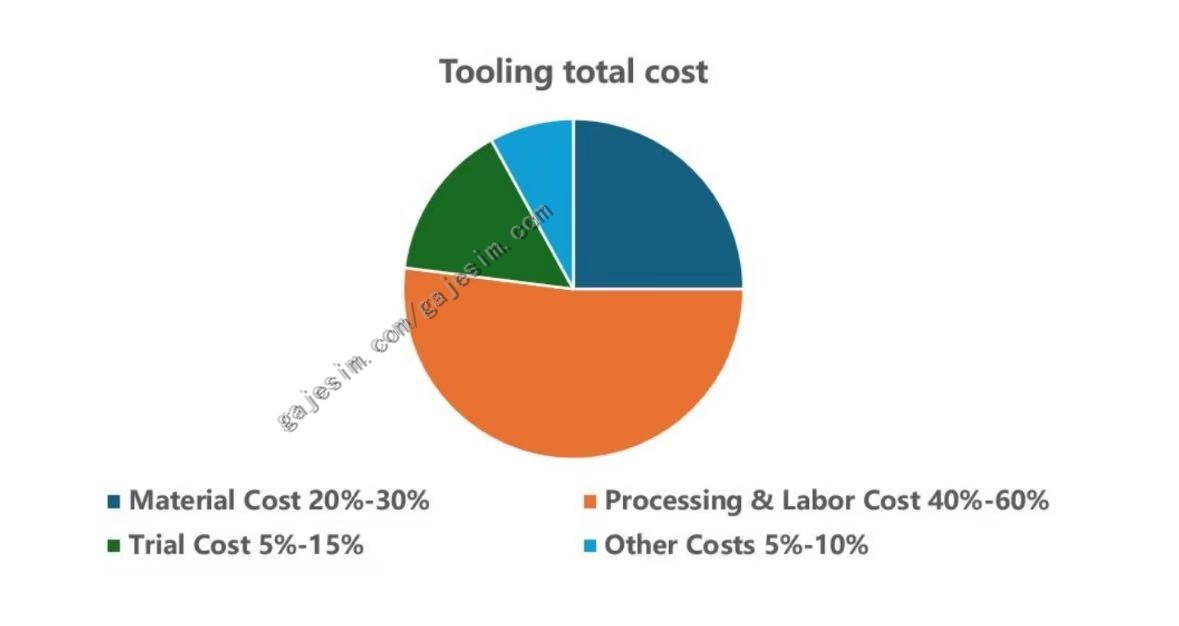
1. Material Cost - Approximately 20% - 30% of the total cost
This part constitutes the "physical" component of the mold, representing the visible cost in terms of materials.
| Category | Explain | Cost influencing factors |
| Cavity Steel | Core steel used for machining the front and back molds (core and cavity). | 1. Steel Brands and Types • Common Pre-hardened Steel (e.g., P20): Features lower costs. • High-grade Mirror Steel (e.g., S136H, Stavax): Offers corrosion resistance and high polishability, but comes with high costs. • Hardened Steel (e.g., H13): Provides high hardness and wear resistance at a high cost. 2. Dimensions and Weight • Mold Insert Size (L * W * H): Directly determines the volume of the steel material. • Unit Price of Steel (Yuan/Kg): The cost per kilogram of the material. |
| Mold Base | Standardized mold plates (A/B plates, top/bottom plates, etc.), leader pins, and bushings. | 1. Dimensions (尺寸) • Size (L * W * H): The larger the dimensions, the higher the cost. 2. Brand and Quality • Brand and Quality: Renowned brands offer stable quality at a slightly higher price; for instance, Gajes Mold frequently uses LKM. 3. Add-ons and Customization • Upcharges: Additional costs will apply for features such as adding support pillars or using hardened plates. |
| Standard Components | Off-the-shelf components purchased from suppliers. |
1. Hot Runner System - Hot Runner System: A major cost item! -Brands: We typically use Mold-Masters at Gajes Mold (other brands include Yudo and Mastip). -Specifications: Cost is determined by the number of nozzles and the control method. 2. Ejector Pins and Sleeves -Ejector Pins / Sleeves: Quantity and material (Standard vs. High-Speed Steel). 3. Lifters and Slider Assemblies -Lifter Mechanisms / Slider Assemblies: Quantity and level of complexity. 4. Others -Miscellaneous: Hydraulic cylinders, pneumatic cylinders, springs, cooling quick-connectors, etc. |
2. Processing & Labor Cost - Approximately 40% - 60% of the total cost
This part is the "soul" of the mold, involving technology, equipment and human resources. It is also the section with the greatest cost variance.
Processing Stage
| Explain | Involving equipment and cost drivers |
| Design | 3D Mold Partitioning & 2D Machining Drawings | Design engineer man-hours and complexity. |
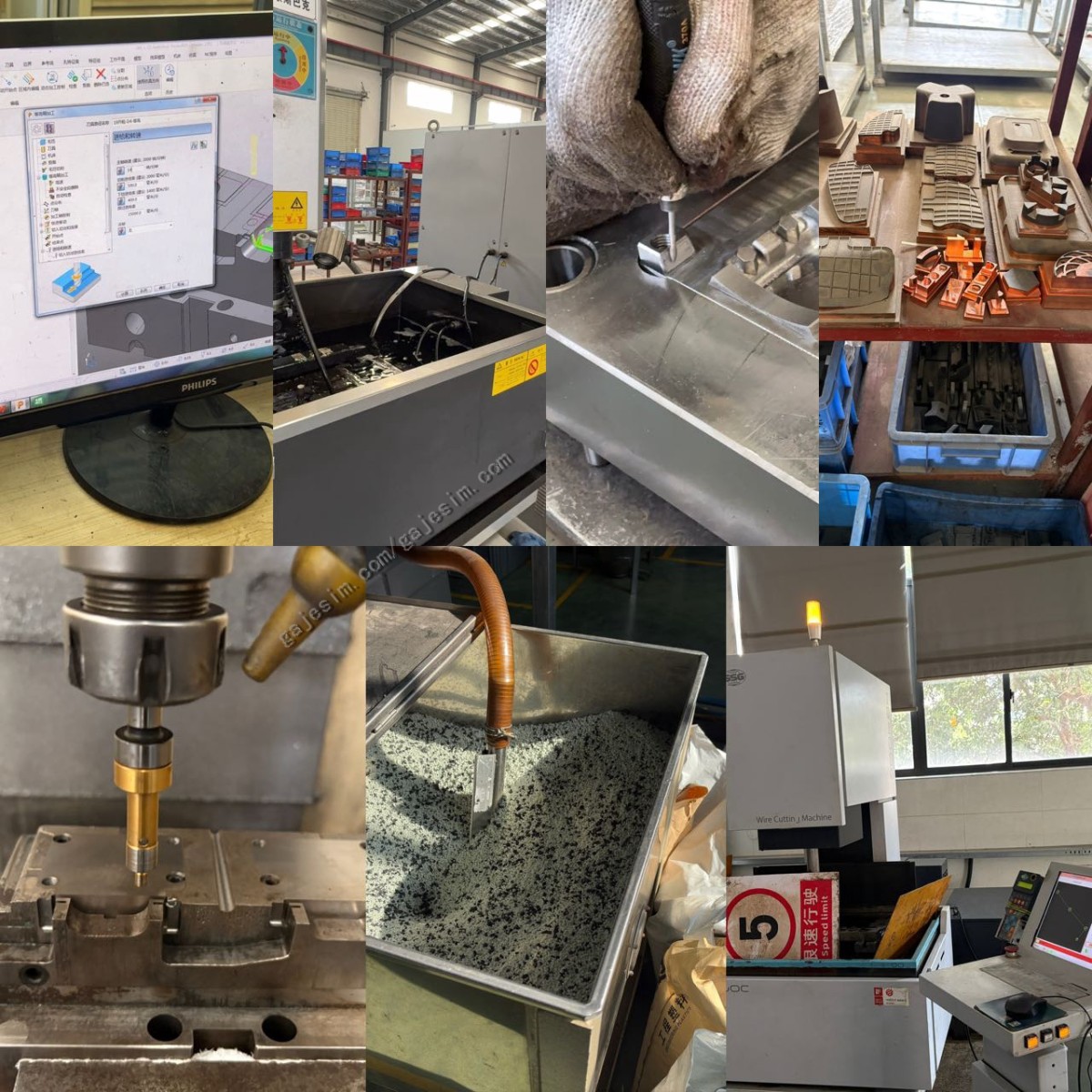
| CNC Rough Machining | Rapid removal of bulk material using large machines | Equipment hourly rates and machining time (depends on steel hardness and part size). |
| CNC Finish Machining | Precision machining using high-speed machines to achieve the final shape | Equipment hourly rates (higher due to precision requirements) and machining time (depends on surface quality requirements and detail level). |
| EDM (Electrical Discharge Machining) | Machining deep grooves, sharp corners, and complex textures that CNC cannot reach | Electrode costs (copper material and CNC machining time) and machining time (highly time-consuming and expensive). |
| Wire EDM / Wire Cutting | Machining precise straight holes and irregular openings | Machining time (calculated as Yuan/mm²). |
| Polishing / Texture | Achieving the required surface finish | High labor costs for polishing; higher grades (e.g., #A1, #A2) lead to exponential cost increases. Texturing (Chemical Etching) is charged by surface area and texture complexity. |
| Bench Assembly / Fitting | Assembling, debugging, and fitting all components together | Man-hours for senior technicians, reflecting technical skill and experience. |
| Heat Treatment | Increasing surface hardness (Nitriding) or overall hardness (Quenching) | Charged by weight or quantity of parts. |
| Surface Treatment | Applying chrome or titanium plating to the mold inserts to increase wear resistance | Charged by surface area. |

3.TrialCost - Approximately 5% - 15% of the total cost
This portion represents the expenses incurred for verifying the functionality and quality of the molds.
| Project | Explain
| Cost influencing factors |
| Trial Material Fee | The plastic resin used during the mold trial. | Material type, number of trials, and part weight. |
| Machine Tonnage Fee / Press Hourly Rate | The cost associated with using the injection molding machine. | Machine tonnage (larger tonnage is more expensive), duration (charged by the hour or per trial), and region (electricity and labor costs vary by location). |
| Labor and Energy Consumption | The man-hours for trial technicians and setup operators, as well as the equipment's power consumption. | The complexity and number of mold trials. |
4.Other Costs - Approximately 5% to 10% of the total cost
How to Evaluate Quotes?
Request Itemized Quotations: Ask suppliers to provide a detailed cost breakdown rather than a single lump-sum price.
Focus on Key Items:
Steel: What brands and grades are used? Are the dimensions reasonable?
Standard Parts: What brand is the hot runner? Are the sliders standard components or custom-made?
Machining: Which parts use CNC versus EDM? What is the polishing grade?
Mold Trials: How many free trials are included?"Apples-to-Apples" Comparison: Ensure quotes from different suppliers are based on identical technical requirements
(steel grade, component brands, mold life, warranty, etc.); otherwise, a low price may indicate "cutting corners."
Gajes Mold Commitments:
Item 1: Gajes Mold provides detailed itemized quotations for components rather than a single total price.
Item 2: We flexibly select steel grades based on your budget and requirements. We generally use Mold-Masters for hot runners, and we determine
whether to use standard or custom sliders based on your specific mold design. Machining processes (CNC, EDM) and polishing grades are executed strictly according
to your specifications. Mold trials continue until the product and client acceptance are fully qualified.
office@gajesim.com
WhatsApp:8619198137646
Gajes Mold Technology Co., Ltd.