
A Technical Analysis of Injection Molding Defects: Causes and Engineering Solutions
Injection molding is a precise manufacturing process governed by thermodynamics and fluid mechanics.When defects occur, they are rarely random accidents; they are physical indicators that the balance between temperature, pressure, and time has been disrupted.This article provides a scientific breakdown of the four most common molding anomalies and the standard engineering protocols to resolve them.
1. Flash: The Issue of Clamping Force

The Phenomenon:
Flash appears as a thin, unwanted film of plastic extending beyond the parting line or product edge.
Technically, flash occurs when the injection pressure inside the mold cavity exceeds the clamping force of the machine.Factors contributing to this include loose mold fitting surfaces (wear), excessive injection speed, or inadequate venting that forces the mold open.
Engineering Correction:
To rectify this, the mold fitting accuracy must be restored to ensure a hermetic seal.Process-wise, the injection pressure and velocity should be reduced, while clamping force is optimized to withstand the internal cavity pressure.
2. Sink Marks: Volumetric Shrinkage

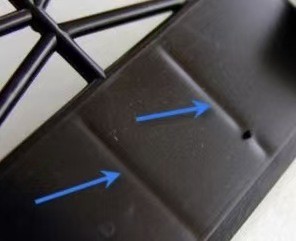
The Phenomenon:
Localized depressions or "dents" are observed on the surface, primarily in thick-walled sections.Plastic shrinks as it cools. In thicker areas, the material cools slower than the surface.If the "holding pressure" is insufficient or applied for too short a time, there is no extra material packed into the cavity to compensate for this shrinkage, causing the surface to collapse inward.
Engineering Correction:
The primary solution involves extending the holding time and increasing the holding pressure to compact the melt density.Additionally, adjusting mold temperature ensures uniform cooling rates across the part.
3. Silver Streaks: Moisture and Volatiles


The Phenomenon:
Silver-colored, splash-like streaks appear on the surface, following the direction of the material flow.The dominant cause is usually hydrolysis or moisture vaporization.When raw materials contain excess moisture, the water turns into steam inside the high-temperature barrel. These gas bubbles are trapped in the melt stream and stretched across the surface.
Engineering Correction:
Pre-processing is critical: materials must be thoroughly dried to remove moisture content.Furthermore, improving the mold’s venting system helps trapped gas escape, and reducing injection speed prevents material degradation from shear heat.
4. Weld Lines: Thermal Fusion Failure
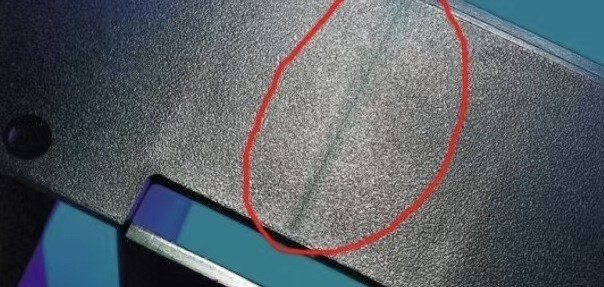
The Phenomenon:
A visible line forms where two or more flow fronts of molten plastic meet but fail to merge completely.This is a thermodynamic issue. If the melt temperature is too low or the flow speed is too slow, the leading edges of the plastic cool down before they meet.
Engineering Correction:
To enhance fusion, the energy state of the melt must be raised by increasing barrel and mold temperatures.Optimizing gate positions and overflow wells also ensures that the flow fronts meet at a higher temperature and pressure.
Summary:
Quality control is simply the disciplined application of physics.By understanding the root causes of these defects—whether it is pressure, heat, or moisture—we ensure that your product is not just manufactured, but engineered to perfection.
office@gajesim.com
Gajes Mold Technology Co., Ltd.
Navigation
Get Quote